Industrial Steam Cleaner Buying Guide: How to Choose the Right Machine
Selecting the right industrial steam cleaner can be the difference between a clean, efficient production line and years of frustration with underpowered equipment. This guide walks through every critical specification you need to evaluate before making a capital purchase, from power sources and pump quality to safety certifications and after-sales support.
1. Power Source: Electric, Diesel, or Gas?
The power source determines where and how you can operate the machine. Electric models dominate factory floors where grid power is available, while diesel and gas units excel in remote locations and outdoor applications.
| Power Source | Best For | Max Output | Portability | Operating Cost |
|---|---|---|---|---|
| Electric (380V) | Indoor factory floors, fixed installations | Up to 48 kW | Low (stationary) | Lowest |
| Electric (220V) | Light industrial, workshops | Up to 6 kW | Medium | Low |
| Diesel | Outdoor sites, mining, railways | Up to 40 kW equivalent | High (trailer-mounted) | Medium |
| Gas (LPG/NG) | Continuous outdoor operation | Up to 36 kW equivalent | High | Medium |
For most manufacturing facilities, a 380V three-phase electric steam cleaner offers the best balance of power, reliability, and operating cost. Diesel and gas units are preferred when grid power is unavailable or when the machine must be moved between remote sites.
2. Pressure and Temperature Ratings
Steam temperature and pressure directly determine cleaning effectiveness on heavy grease, oil, and baked-on contaminants. Industrial-grade machines should deliver:
- Temperature: 170–220°C saturated steam for effective degreasing and sanitization
- Pressure: 6–30 bar adjustable, with higher pressure needed for stubborn deposits and deep pores
- Steam volume: Measured in kg/h; higher flow covers more surface area per minute
- Dry/wet steam adjustment: Critical for applications where excess water must be minimized
A common mistake is buying a machine rated for peak pressure that it cannot sustain during continuous operation. Always verify the rated pressure is available at the nozzle during 24-hour duty cycles, not just in short bursts.
3. Pump Quality: The Heart of the Machine
The high-pressure pump determines reliability and maintenance intervals. Italian AR (Annovi Reverberi) plunger pumps are the industry standard for continuous-duty industrial steam cleaners, offering:
- Brass manifold construction for corrosion resistance
- Ceramic plungers for extended seal life
- Rated for 24-hour continuous operation
- Readily available spare parts worldwide
Avoid machines with unbranded or generic pumps. Pump replacement costs and downtime will quickly erase any upfront savings.
4. Safety Certifications: Non-Negotiable for Industrial Use
Safety certifications protect your workers, your facility, and your regulatory compliance. At minimum, verify the following:
| Certification | Scope | Required For |
|---|---|---|
| ATEX (2014/34/EU) | Explosive atmospheres | EU market, Zone 1/2 environments |
| EAC (TR CU 012/2011) | Explosive atmospheres | Eurasian Customs Union markets |
| CE | General safety | EU market |
| ISO 9001/14001/45001 | Quality, environment, safety management | Tender and procurement compliance |
| Third-party test report | Full machine performance verification | Buyer due diligence |
If your facility handles flammable materials, operates in classified zones, or needs to pass tender requirements, ATEX and EAC certifications are mandatory — not optional upgrades.
5. Control System: PLC vs Manual
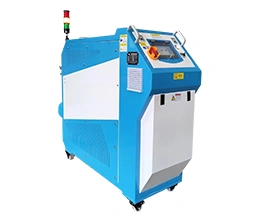
Modern industrial steam cleaners offer PLC (Programmable Logic Controller) systems with 10-inch touchscreens, providing precise control over temperature, pressure, steam volume, and cycle timing. Benefits of PLC control include:
- Recipe storage for different cleaning tasks
- Real-time monitoring of pump pressure and boiler temperature
- Fault diagnostics with error codes displayed on screen
- Automatic shutdown on abnormal conditions
- Data logging for quality management systems
Manual control panels are acceptable for simple, single-task machines but lack the flexibility and safety interlocks required for multi-product facilities.
6. Water Treatment and Maintenance
Hard water is the number one cause of premature boiler failure. Look for machines equipped with:
- Built-in water softening or demineralization
- Automatic descaling cycles
- Boiler auto-blowdown for sediment removal
- Replaceable scale filter cartridges
Without proper water treatment, scale buildup reduces heating efficiency, increases energy consumption, and shortens boiler life from years to months.
Buying Checklist
- Define your cleaning task: what contaminants, what surfaces, what throughput?
- Confirm power availability at the installation site (voltage, phase, amperage)
- Check required safety certifications for your industry and market
- Verify pump brand and continuous-duty rating
- Request a third-party test report for the specific model
- Confirm warranty coverage: minimum 3 years on the full machine
- Ask about local service availability and spare parts stock
- Request an on-site demonstration or factory acceptance test
Need Help Selecting Your Steam Cleaner?
JIENENG manufactures a full range of industrial steam cleaners from 6 kW to 48 kW, with ATEX and EAC certified models available. Our engineering team helps you match the right machine to your application.
Request a ConsultationSummary
Choosing the right industrial steam cleaner requires evaluating power source, sustained pressure and temperature, pump quality, safety certifications, control sophistication, and water treatment. By following the checklist above and insisting on verified specifications rather than marketing claims, you can select a machine that delivers reliable performance for years. JIENENG offers models across the full power range with dual international explosion-proof certification and a standard 3-year warranty.