Industrial Pressure Washer Buying Guide: Electric vs Diesel vs Gas
Selecting an industrial pressure washer is a capital decision that affects cleaning productivity, operating costs, and safety for years. The wrong choice — whether undersized for the task or overpowered for the environment — leads to wasted money and unsatisfactory results. This guide breaks down the critical decision factors: hot vs cold water, power source selection, pressure and flow rate requirements, pump quality, and essential features.
Hot Water vs Cold Water: The First Decision
The most important choice in pressure washer selection is whether you need hot water. Cold water pressure washers are suitable for removing loose dirt, dust, and water-soluble contaminants. Hot water pressure washers — which heat water to 80–95°C — are essential for removing oil, grease, wax, and any hydrocarbon-based contamination.
Hot water cleaning is 30–50% faster than cold water for oily contaminants because heat reduces oil viscosity, allowing it to flow off the surface. The thermal energy also improves detergent effectiveness if chemicals are used. For any facility dealing with machinery, vehicles, food processing, or manufacturing residues, hot water is not optional — it is a requirement.
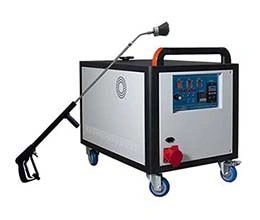
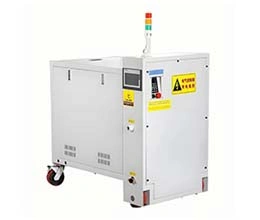
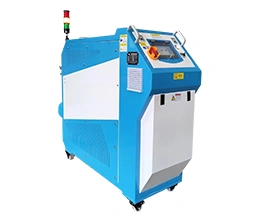
Some industrial steam cleaners combine both capabilities: they can deliver cold water, hot water, and wet or dry steam from a single unit, providing maximum versatility. JIENENG's JNX series offers this multi-mode functionality across models ranging from 6 kW to 48 kW.
Power Source Comparison: Electric vs Diesel vs Gas
The power source determines where and how the pressure washer can operate, its running costs, and its maintenance requirements.
| Factor | Electric | Diesel | Gas (LPG/Natural Gas) |
|---|---|---|---|
| Ideal environment | Indoor, fixed location | Outdoor, remote sites | Outdoor, semi-mobile |
| Power range | 2–50+ kW | 10–75+ kW equivalent | 5–30 kW equivalent |
| Operating cost (per hour) | Low ($0.50–$3.00) | Medium ($2.50–$8.00) | Medium ($1.50–$5.00) |
| Emissions | Zero (at point of use) | Diesel exhaust + noise | Lower emissions than diesel |
| Maintenance | Low (no engine) | High (engine oil, filters, injectors) | Medium (engine maintenance) |
| Mobility | Fixed or limited by cable | Fully mobile, self-contained | Semi-mobile |
| Initial cost | Medium | High | Medium-High |
| Noise level | Low (65–75 dB) | High (85–100+ dB) | Medium-High (80–95 dB) |
Electric Pressure Washers
Electric models are the default choice for indoor industrial facilities. They produce zero exhaust emissions, operate quietly enough for conversation nearby, and require minimal maintenance — no oil changes, no fuel filters, no engine servicing. The limitation is that they require a suitable electrical supply (220V single-phase for small units, 380V three-phase for 10 kW and above) and are tethered to a power source.
Diesel Pressure Washers
Diesel models excel in outdoor and remote applications: construction sites, mining operations, agriculture, and large vehicle fleets. They are self-contained with onboard fuel tanks and often self-priming water pumps that can draw from tanks or natural water sources. The trade-offs are higher noise levels, exhaust emissions, and significantly more maintenance. Diesel burners are also the standard for heating water in mobile hot water units.
Gas (LPG / Natural Gas) Pressure Washers
Gas-powered units occupy a middle ground. LPG models produce fewer emissions than diesel and are sometimes permitted in semi-enclosed spaces where diesel is not. Natural gas models can be connected to building gas lines for continuous operation without refueling. These are less common in industrial settings but appear in food processing facilities and agricultural operations where gas is already available.
Pressure and Flow Rate: Understanding the Numbers
Pressure (measured in bar or PSI) and flow rate (liters per minute or GPM) work together to determine cleaning effectiveness. A common mistake is focusing solely on pressure. In reality, flow rate is often more important for industrial applications because it determines how much contaminant can be flushed away.
| Application | Pressure (bar) | Flow Rate (L/min) | Recommended Type |
|---|---|---|---|
| Light vehicle washing | 50–110 | 6–10 | Cold water, electric |
| Fleet vehicle degreasing | 120–180 | 10–15 | Hot water, electric or diesel |
| Machinery & equipment cleaning | 150–200 | 10–20 | Hot water / steam, electric |
| Concrete & surface preparation | 200–300 | 15–25 | Cold or hot, diesel |
| Heavy industrial descaling | 300–500+ | 20–40 | Ultra-high pressure, diesel |
| Industrial steam degreasing | 6–20 (steam) | Steam quality dependent | Steam cleaner, electric |
Pump Quality: The Heart of the Machine
The high-pressure pump is the single most critical component determining equipment longevity and reliability. Industrial pressure washers and steam cleaners should use axial or triplex plunger pumps from recognized manufacturers.
- Italian AR (Annovi Reverberi) pumps: The industry standard for industrial cleaning equipment, known for ceramic plungers, forged brass manifolds, and continuous-duty ratings. JIENENG uses AR pumps across its product line for 24-hour continuous operation capability.
- Ceramic plungers: Essential for durability. Ceramic resists wear from high-pressure water and abrasive particles far better than hardened steel. Expect 3,000–5,000 operating hours before service.
- Forged brass manifolds: Stronger and more corrosion-resistant than aluminum. Required for pressures above 150 bar.
- Bypass valve protection: Prevents pump damage when the trigger is released. Unloader valves should be adjustable and serviceable.
Essential Features to Look For
- Adjustable pressure regulation: Allows safe cleaning of delicate surfaces at low pressure and aggressive cleaning at maximum pressure
- Thermal protection: Automatic shutdown on pump overheating or low water supply — critical for unattended operation
- Stainless steel or powder-coated frame: Corrosion resistance for wet industrial environments
- PLC + touch screen control (on advanced models): Enables programmable cleaning cycles, parameter logging, and remote monitoring
- Multi-mode operation: Systems that deliver cold water, hot water, and steam from one unit provide maximum flexibility
- Water treatment integration: Built-in water softening and filtration extends pump life and prevents scale deposits
Safety Considerations
Industrial pressure washers generate enough force to cause serious injury. Proper safety features and protocols are non-negotiable:
- Trigger gun with safety lock to prevent accidental discharge
- Pressure relief valve to prevent over-pressurization beyond rated capacity
- Thermal dump valve on hot water units to prevent scalding from superheated water
- Electrical ground fault protection on all electric models
- Appropriate PPE: safety goggles, cut-resistant gloves, steel-toed boots, and hearing protection for diesel units
- Exhaust extraction ventilation for indoor diesel operation
Need Help Choosing the Right Pressure Washer?
JIENENG offers electric and diesel industrial cleaning systems from 6 kW to 48 kW, with Italian AR pumps, PLC control, and multi-mode steam/hot/cold operation. Tell us your application and we will recommend the optimal configuration.
Get a RecommendationSummary
Choosing the right industrial pressure washer requires matching three core factors to your application: water temperature (hot for oil and grease, cold for dirt and dust), power source (electric for indoor fixed locations, diesel for outdoor mobile use), and pressure/flow specifications appropriate for your cleaning tasks. Invest in equipment with quality pumps (Italian AR with ceramic plungers), adjustable pressure regulation, and safety protection features. For facilities that need maximum versatility, multi-mode steam cleaners that deliver cold water, hot water, and dry steam from a single unit provide the best long-term value and eliminate the need for multiple machines.