Solar Panel Cleaning Robot ROI: How Much Can You Save?
Dust, pollen, bird droppings, and industrial pollution accumulate on solar panels continuously, reducing energy output by 15–30% in moderate environments and up to 50% in arid regions. Solar panel cleaning robots eliminate the labor cost and water waste of manual cleaning while recovering lost energy production. This guide quantifies the financial return and helps you evaluate whether robotic cleaning makes sense for your PV installation.
The Cost of Dirty Panels
Soiling loss — the energy production reduction caused by surface contamination — is the single largest controllable loss factor in utility-scale solar. The impact varies dramatically by environment:
| Environment Type | Annual Soiling Loss | Cleaning Frequency Needed |
|---|---|---|
| Arid/desert (Middle East, North Africa) | 25–50% | Weekly to biweekly |
| Semi-arid (Australia, India, US Southwest) | 15–30% | Biweekly to monthly |
| Agricultural/rural | 10–20% | Monthly to quarterly |
| Urban/industrial | 8–15% | Quarterly to semiannually |
| High rainfall temperate | 3–8% | Semiannually or as needed |
For a 10 MW solar farm generating at $0.05/kWh, a 20% soiling loss translates to approximately $120,000 in lost revenue annually. Recovering even half of that loss through regular cleaning delivers substantial returns.
Manual vs Robotic Cleaning: Cost Comparison
| Factor | Manual Cleaning | Robotic Cleaning |
|---|---|---|
| Labor cost per MW/clean | $300–$800 | $20–$50 (operator + maintenance) |
| Water consumption per MW | 5,000–15,000 L | 500–2,000 L |
| Cleaning speed | 0.5–1 MW/day per crew | 2–5 MW/day per robot |
| Panel damage risk | Medium (brushing, foot traffic) | Very low (no human contact) |
| Consistency | Variable by worker | Consistent, programmable |
| Night operation | No (safety risk) | Yes (autonomous scheduling) |
| Access to difficult areas | Limited | Designed for all panel layouts |
ROI Calculation Example: 10 MW Solar Farm
Consider a 10 MW utility-scale solar farm in a semi-arid region with 20% soiling loss, generating $600,000/year at full output. Here is a simplified ROI analysis:
- Energy loss from soiling: 20% × $600,000 = $120,000/year lost
- Energy recovered by cleaning: Assume 85% recovery = $102,000/year recovered
- Manual cleaning cost: Monthly cleaning × $500/MW × 10 MW × 12 = $60,000/year
- Robotic cleaning cost: Robot purchase $45,000 + annual operating cost $8,000 = $53,000 year one, $8,000/year thereafter
- Net annual benefit (robotic): $102,000 - $8,000 = $94,000/year (after year one)
- Payback period: $45,000 / ($94,000 - $40,000 manual equivalent) ≈ 3–5 months
In this scenario, the robotic cleaner pays for itself within the first quarter of operation and delivers over $90,000 in net annual savings thereafter. Larger installations or higher soiling environments achieve even faster payback.
Types of Solar Panel Cleaning Robots
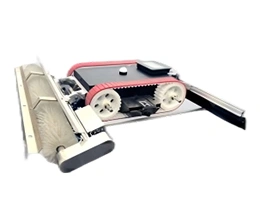
- Crawler/treaded robots: Move directly across panel surfaces using rubber or polymer tracks. Best for large, flat rooftop and ground-mount arrays. JIENENG's JNX-L is a treaded crawler designed for continuous operation.
- Rail-mounted robots: Travel on permanent rails installed along panel rows. Highest speed and autonomy but requires infrastructure investment. Ideal for large utility farms with uniform panel layouts.
- Brush robots: Use rotating brushes with minimal or no water. Suitable for arid regions where water is scarce and dust is dry and loose.
- Hybrid robots: Combine dry brushing with low-pressure water spray for environments with both loose dust and adhered contamination (bird droppings, pollution residue).
Key Features to Evaluate
- Autonomy: Fully autonomous robots with programmable routes reduce labor to near zero
- Water efficiency: Look for systems using under 2 L per MW or dry-cleaning capability
- Panel compatibility: Verify the robot works with your panel type (glass, film, bifacial) and mounting angle
- Battery life: Should cover at least one full row cleaning cycle per charge
- Remote monitoring: IoT connectivity for cleaning schedule tracking and fault alerts
- Weather resistance: IP65 or higher for outdoor operation in all conditions
- Weight: Must not exceed panel load ratings — typically under 15 kg per contact point
Cleaning Frequency Guidelines
Optimal cleaning frequency depends on soiling rate, energy price, and cleaning cost. A simple rule: clean when the cost of lost energy exceeds the cost of cleaning. For most semi-arid installations, biweekly to monthly cleaning maximizes net revenue. In desert environments, weekly cleaning may be justified given the extreme soiling rates.
Ready to Automate Your Solar Cleaning?
JIENENG's JNX-L crawler-type solar panel cleaning robot is designed for continuous, water-efficient cleaning of utility-scale PV arrays. Contact us for a customized ROI analysis based on your installation.
Get Your ROI AnalysisSummary
Solar panel cleaning robots deliver compelling ROI for virtually any utility-scale installation in moderate-to-high soiling environments. With payback periods of 3–5 months for typical 10 MW farms, robotic cleaning eliminates the labor cost, water waste, and panel damage risk of manual methods while recovering 15–30% of lost energy production. The key to maximizing returns is matching robot type and cleaning frequency to your specific environmental conditions and panel configuration.